Huawei Alarm 2062 Error: Low Insulation Resistance
Troubleshoot Huawei SUN2000 alarm 2062 (low insulation resistance to earth).
Insulation resistance between the DC photovoltaic array and ground has dropped below the safety threshold (Low Insulation Resistance to earth).
Probable Causes
DC string conductor crushed, pinched, or abraded against sharp rooftop racking edges.
Moisture accumulation inside Amphenol/MC4 connectors or SUN2000P power optimizer casings.
Degraded solar module backsheet allowing dielectric leakage during damp atmospheric conditions.
Diagnostic & Testing Steps
- •Major alarm 2062 flagged on FusionSolar app and cloud management portal.
- •Immediate shutdown of solar generation with status LED slowly blinking red.
- •Failed daily insulation impedance self-check during morning power-up sequence.
Tools & Equipment Required
- ✓1000V Digital Insulation TesterMeasure DC array insulation resistance to ground (> 100 kΩ threshold on SUN2000).
- ✓CAT III 1000V Digital MultimeterMeasure open-circuit voltage of each PV string and verify no inverted polarity.
- ✓MC4 PV Terminal Wrench SetIsolate individual DC strings to identify the specific faulted branch.
- ✓Class 0 1000V Insulated Rubber GlovesSafety gear for handling live photovoltaic array conductors.
- ✓Phillips #2 Insulated ScrewdriverOpen DC switch compartment and check ground busbar clamping torque.
Fast Reset Sequence: Solar Inverter Safe AC/DC Shutdown & Reboot Sequence
Before unmounting panels or beginning diagnostic procedures, attempt this manufacturer reset to clear transient microcomputer lockouts:
- 1.Step 1: Switch OFF the dedicated AC circuit breaker at the main electrical distribution panel.
- 2.Step 2: Turn the rotary DC Disconnect Switch on the underside of the inverter to the OFF (0) position.
- 3.Step 3: Wait a minimum of 5 to 10 minutes to allow high-voltage DC capacitors to bleed down to 0V.
- 4.Step 4: Re-engage the DC disconnect first, followed by switching ON the AC breaker.
- 1
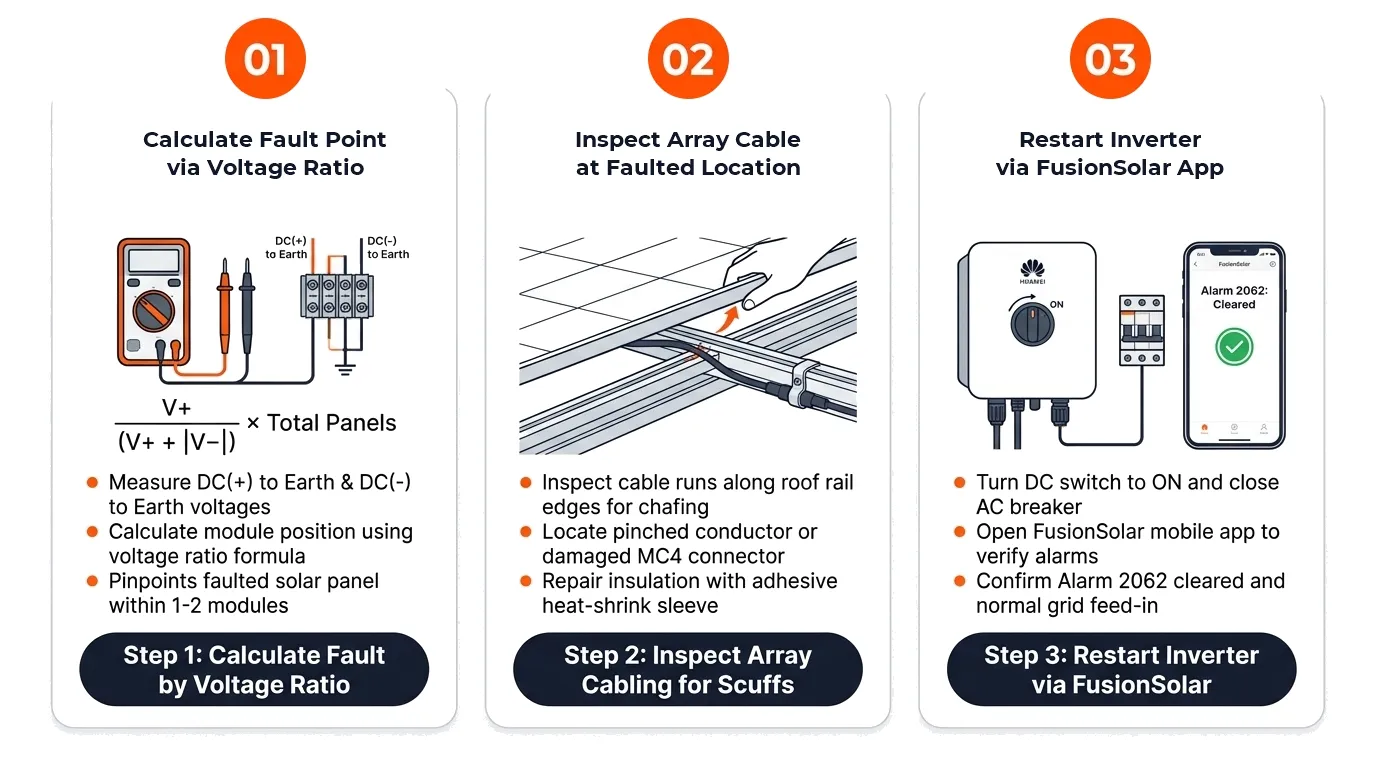
Step 1: Calculate Fault Location Using Voltage Ratio Method
[ ] DoneCarefully measure DC voltage from positive to earth (V+) and negative to earth (V-) to calculate the relative position of the ground fault.
Verification:The formula V+ / (V+ + |V-|) x Panel Count identifies the suspected module within 1-2 panels. - 2
Step 2: Inspect Array Cable Runs at Suspected Location
[ ] DoneExamine cable ties, conduit, and connectors near the calculated module position for visible scuffing or water infiltration.
Verification:Faulty wire is identified, repaired with UV-rated adhesive heat-shrink tubing, and elevated off the roof deck. - 3
Step 3: Perform System Restart Test via FusionSolar
[ ] DoneReconnect DC strings, turn DC SWITCH to ON, close the AC breaker, and verify system status on the mobile app.
Verification:Alarm 2062 clears from the active alarms list and green LED flashes slowly before grid feed-in.
Repair Solutions
Disconnect all DC inputs and measure DC voltage from each pole to earth to calculate ground fault location.
Inspect rooftop cable trays and replace pinched or heat-degraded wire sections.
Test power optimizers individually and re-terminate damaged connectors with IP68 waterproof sleeves.
Frequently Asked Questions
How do I clear Alarm 2062 on FusionSolar?
Alarm 2062 automatically self-clears once the inverter measures insulation resistance above the configured safety threshold during power-up.
Is the Huawei V+/V- ground fault calculation accurate?
Yes, measuring V+ and V- relative to ground typically locates the ground fault within 1 to 2 modules along the string.